
Nvidia has snatched the title of being the World’s First $5-Trillion Market-Cap Company. The Bloomberg said shares were up to 5% higher, trading at above $211 around 9:30AM ET on Wednesday, past week being another milestone for a company that just attained the $4 trillion threshold.
Shares of Nvidia have continued to soar with the company making more and more significant strides in AI. Apple vies for the number two crown with a $4 trillion market cap, followed by Microsoft, Alphabet (Google’s parent company), Amazon, and Meta.
Just a few months back, Nvidia soared past the $4 trillion mark, which was nothing but an industry shock. Now taking a leap to $5 trillion is far from just symbolic, with Nvidia moving from merely being a hardware supplier to becoming a fundamental platform for the AI age. Seen another snapshot: On October 29.
What propelled the surge?
There were a variety of factors that pushed Nvidia into uncharted territory:
- The company stated a backlog of bookings of $500 billion for AI processors, implying huge demand for its hardware.
- Partnerships and initiatives: Nvidia announced the support of the U. S. Department of Energy in the building of seven supercomputers and deals around next-generation connectivity (5G/6G) and other AI infrastructures.
- A shift in the marketplace: With generative AI, large-language models, and compute-heavy systems rising, Nvidia’s GPUs (and software ecosystem) are placed in the bottleneck of that demand.
- There are geopolitics at work: Export controls on advanced chips, specifically on the company’s “Blackwell” architecture, have elevated Nvidia to strategic status amidst U. S.–China tech tensions.
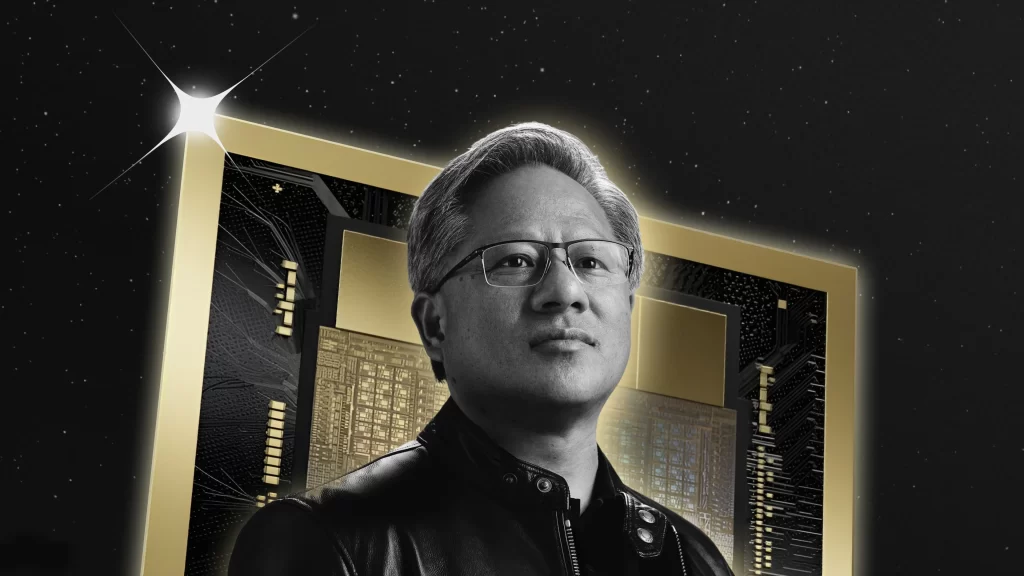
Even as Nvidia’s valuation soars high, the star of the show, CEO Jensen Huang, continues reaching new heights, with an estimated personal territory of around $180 billion.It places him among the richest people in the world, showing both the company’s dominance and outsized role in the tech ecosystem.
What comes next?
NVIDIA will be focused on scaling chip production, scaling software ecosystems (CUDA, AI frameworks), and dealing with any regulatory or export-control hurdles. Of utmost importance is to convert orders and pipeline demand into sustained revenue growth and either margin stability or margin expansion. Success, at least in the current environment, is no longer dependent on “what it sells” but on “how rapidly that demand matures into cash flow and profits.”
Why it matters for you
- For investors: The rise of Nvidia tells a familiar story about platform leadership in a brand-new technology, bringing outsized value but yet also signaling elevated risk if expectations fall.
- For industries: Companies across the spectrum (automotive, telecom, healthcare) see these Nvidia chips as great levers to achieve transformation through AI, so their dependency on Nvidia might well be more structural than many recognize.
- For workers and technologists: Dominance of Nvidia means skills related to their hardware-software stack (GPUs, CUDA, large-model training) are becoming increasingly valuable and increasingly central to the next wave of innovations.
Final word
When the stock price of Nvidia surpassed the mark of $5 trillion, it was not just a number but rather a moment of validation for the entire AI narrative. Whether it would get to define a new era of computing or turn out to be a cautionary tale would be dependent on how that promise delivers itself in reality. For now, Nvidia stands in splendid isolation atop a new summiteering—the summit of tech’s trillion-trillion club.