

It seems that Apple quietly chose to halt production on the iPhone Air, as supply-chain checks and industry reports starting to suggest that demands for the ultra-thin model are not really attaining expectations outside China. The reductions reported in late October came after the other models of Apple’s new iPhone 17 family sold a little better than expected and had already caused suppliers to reevaluate their output targets.
A fast pivot after a cautious launch
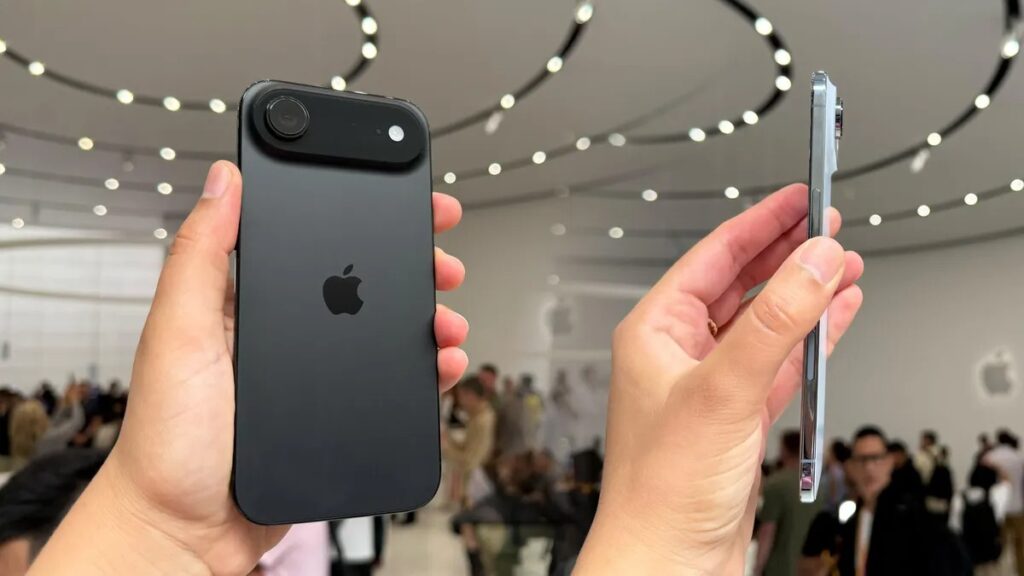
Launched along with the iPhone 17 lineup in September 2025, the iPhone Air was proclaimed as Apple’s lightest, slimmest full-size iPhone-a test in design that combined a few Pro-class features into a wafer thin body. Initial enthusiasm, primarily from the marketers at Apple, did not translate into a strong consumer demand from multiple regions, according to several supply-chain sources and inside reports. This mismatch seemed to have led to a fast production reweighting: Apple has reportedly dialed down iPhone Air orders while increasing the production of base iPhone 17 and Pro models.
How big is the cut?
It seems that different reports cite estimates of different percent of cuts. Some supplier accounts cited by industry publications suggest Air orders for November dropped to some fraction of the September levels-none is reported less than 80%-as Apple redirects capacity to SKUs with greater demand levels. Ming-Chi Kuo has warned that suppliers could resort to large capacity reductions and that the manufacture of some long-lead components might be terminated, if the trend carries forward.
That said, all investor reports may not have taken into the production due to collapse version of events into consideration. TD Cowen and other analysts brought up by later reports consider Apple’s production plans are broadly intact this quarter, calling even now for millions of iPhone Air units to be going into the holiday season. The contradictory investor notes show how difficult it is to interpret Apple’s supply-chain moves in real time.
Why the Air may have faltered
There are a number of reasons on the market level for the Air’s production cut. Firstly, the very high-line iPhones (17, 17 Pro, and Pro Max) seem to have sucked up most high-end demand, leaving little room for a thin and lighter variant priced near flagships. Secondly, a few critics and early buyers pointed toward compromises relevant to daily use: battery life and camera versatility, where one would expect Apple to lead. Thirdly, the bigger smartphone market remains weak in 2025, with longer upgrade cycles and customers voiding on unique features like foldable form factors or revolutionary camera systems.
The supply-chain fallout
With production orders dramatically cut as some reports maintain, the fallout trickles down to Apple’s supply chain. Components related specifically to the Air-thin chassis parts, special displays, or unique mechanical assemblies-may have their orders slashed or deferred, and consequent factory changes and line reassignments could be a reality. Several reports from suppliers and market trackers have already pointed towards urgent changes in shipping and component plans for November. For smaller suppliers, sudden changes in orders can squeeze at their margins and at times cause headache-inducing inventory problems.
What it means for consumers and the product roadmap
For consumers, it may mean that iPhone 17 and Pro units could have an easier time entering the market as supply shifts, while the Air remains largely available online for some time — historically a sign of slowed good movement rather than huge demand. For Apple’s product teams, the data point comes: If a thin, lite flagship at premium price points does not find a broad market, there may therefore be a shift in engineering bandwidth and derived roadmap slots towards more unique innovations such as foldables, camera breakthroughs, or battery and AI feature sets. Some analysts have speculated that the Air could have been an experiment in consumer appetite for new form factors rather than a long-term pillar of the lineup.
Final word
With the tightening of global markets and buyers becoming more value-conscious, Apple will have to fight the bigger challenge of drumming up excitement for what will come thereafter. It would be applied to AI-driven experiences, greater ecosystem integration, or maybe a whole new product category. One thing is for sure, the tech world views Apple as its frontrunner not only to come up with new ideas but to create them.